The Indian workplace design industry has spent two decades getting fluent in the vocabulary of cost — value engineering, rightsizing, optimisation — without using the mathematics underneath any of it. Every adjacent profession that GCC clients hire — finance, operations, supply chain — has moved from vocabulary to quantification in the last twenty years. Workplace design, bluntly, has not. The next decade belongs to the firms that close that gap.
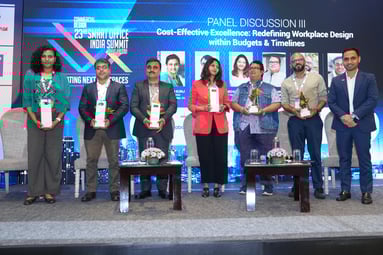
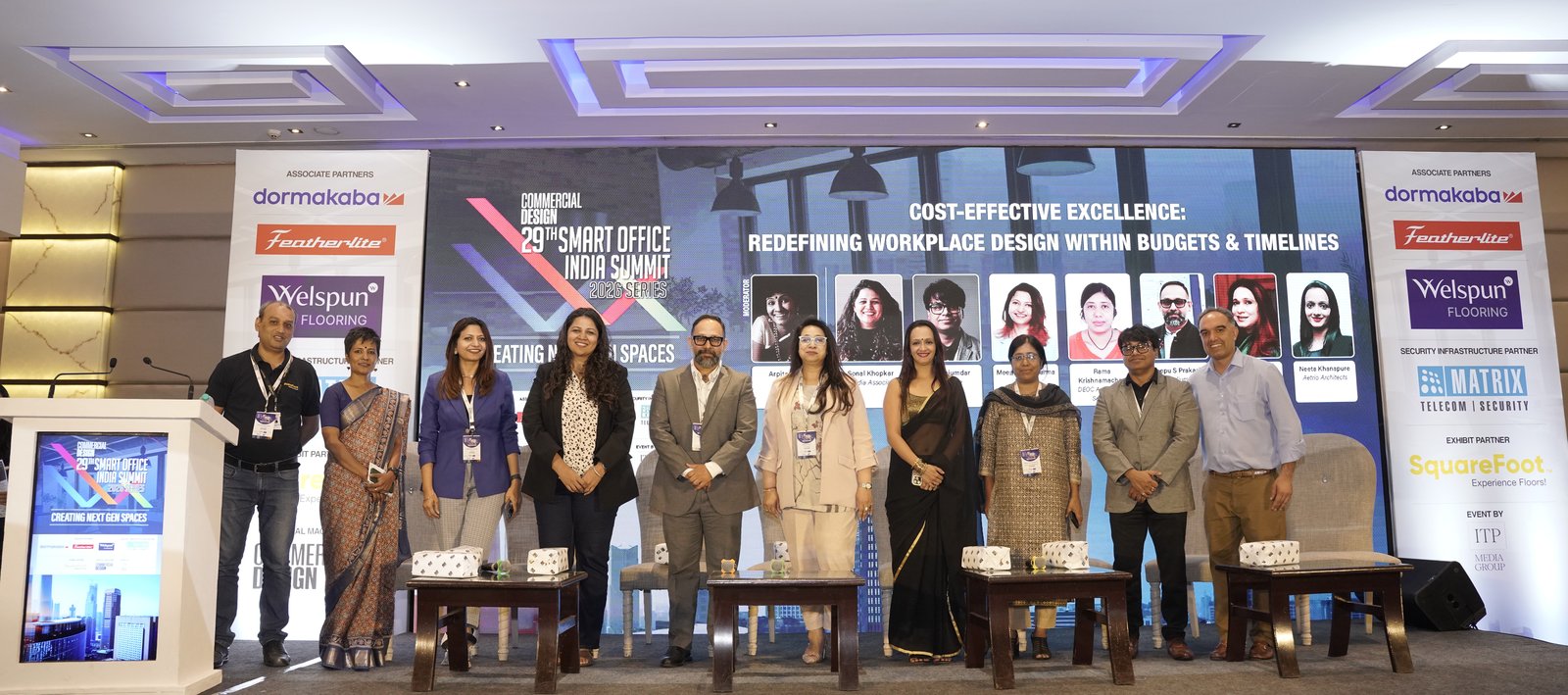
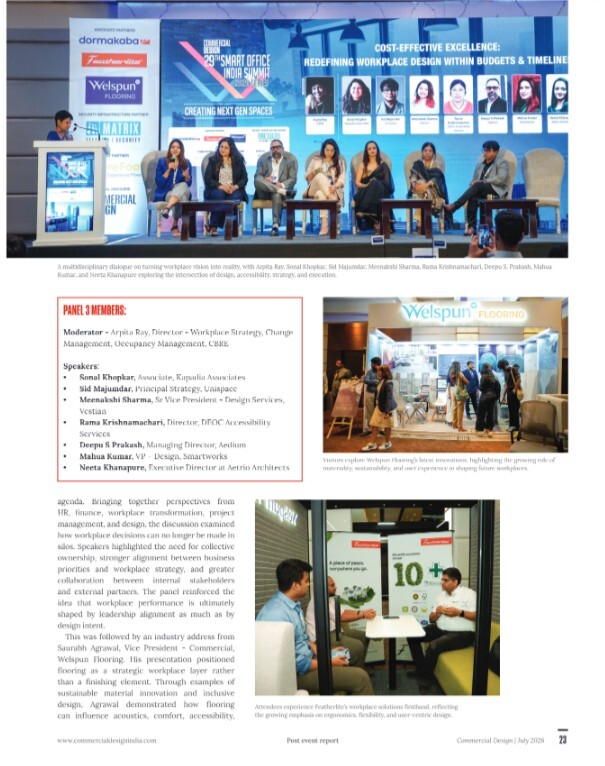
At the 29th Smart Office India Summit, Swatasiddha (Sid) Majumdar, Principal of Strategy at Unispace India, delivered a panel discussion session titled “Cost-Effective Excellence: Redefining Workplace Design within Budgets and Timelines.” Among the panel, Sid stood apart with a clear provocation:
“Cost is not a design problem. It is an optimisation problem. And our industry has been solving it with instinct when there is a formula.”
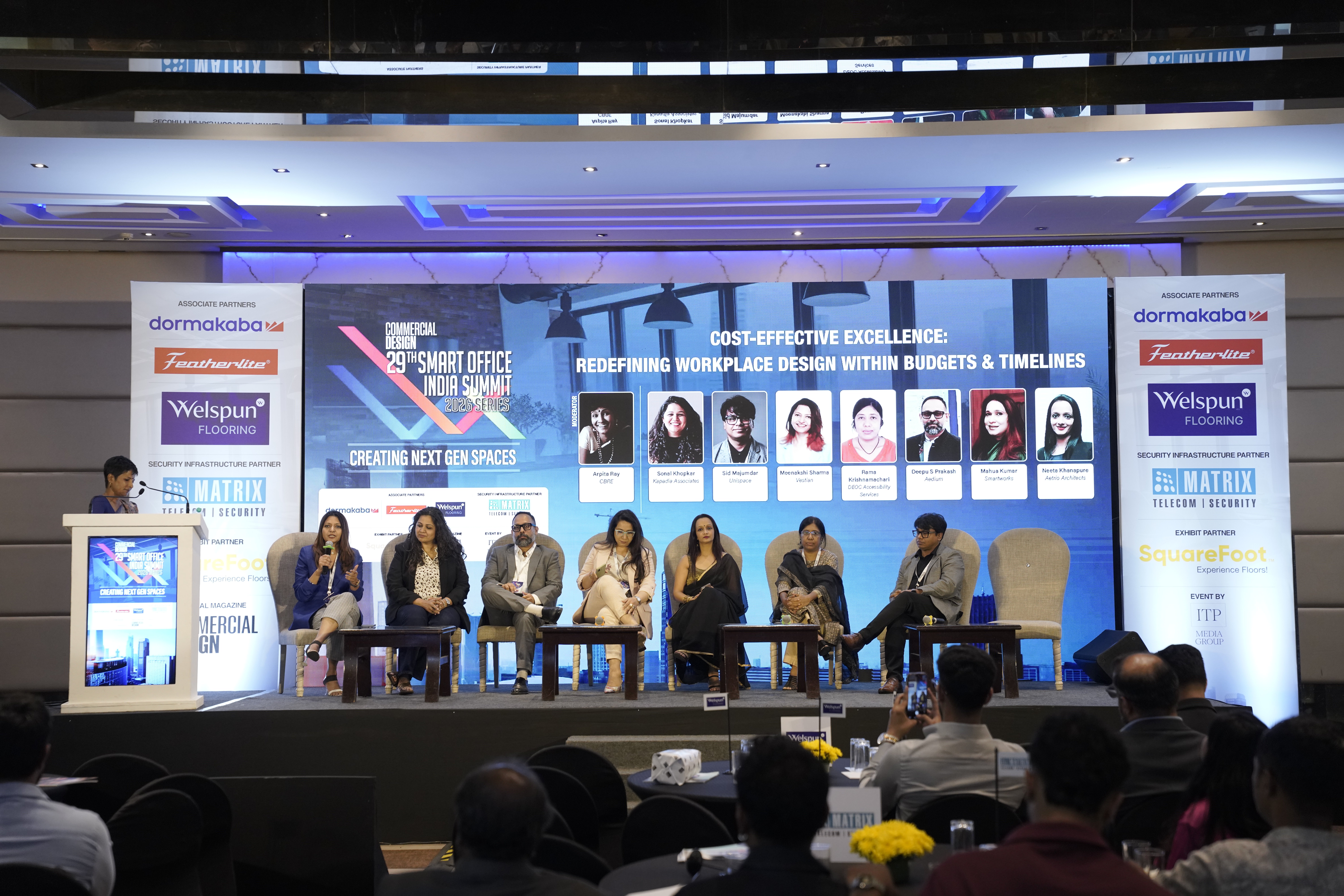
The panel discussion centred on five key areas:
The Opex vs Capex Blind Spot
Across a typical nine-year GCC lease, operating costs run 2.5 to 3 times the initial fit-out capex. Yet sustainable systems are often cut to protect upfront budgets.
As Sid put it:
“When you cut sustainable systems to protect capex, you are protecting the smaller number at the expense of the larger one.”
His rule of thumb:
- Payback within 8 quarters → mandatory
- 8–16 quarters → justify
- Beyond 16 quarters → scrutinise
BIM and Digital Twins: A Disciplined View
The cost of fixing errors escalates exponentially: design (1x), documentation (10x), site (100x), post-occupancy (1000x).
Sid’s recommendation: a federated model review before mobilisation, including sequencing — a low-cost step that avoids high-cost mistakes.
“We are still choosing the several crores, and we are still calling it cost control.”
Decision Latency Drives Overruns
Tight timelines aren’t the issue — delayed decisions are.
Every day of delay early in a project can add nearly two days later due to compounded changes.
The fix: lock in long-lead items within the first two weeks, before design debates escalate.
Pre-Mortem Over Post-Mortem
Most projects analyse failure too late.
“A post-mortem is a confession written too late to matter. A pre-mortem is the same conversation held when it can still change the outcome.”
A two-hour pre-mortem at kickoff can surface risks that would otherwise cost crores.
From Instinct to Mathematics
The industry still designs by intuition — despite decades-old mathematical solutions.
“Workplace is the last major building type where we still design by opinion. That ends this decade.”
Closing Thought
Sid closed with a challenge that cut through the room:
"If you had to defend the capex on your last project using mathematics, not narrative — could you?"
For many organisations, the answer is still no.
For clients who need that answer to be yes, Unispace India is positioning itself as a partner equipped to bridge that gap — bringing rigour, quantification, and accountability to workplace design decisions.
For more insights, Sid regularly shares his thinking and frameworks on LinkedIn — a growing body of work that is steadily reshaping how the industry understands cost, performance, and design itself.
About Swatasiddha Majumdar, Principal, Strategy, India

Swatasiddha (Sid) Majumdar is the Principal, Strategy at Unispace India, a global design and build firm that specializes in workplace strategy, design, project management, and construction. With over two decades of professional experience, Swatasiddha leads the strategic initiatives at Unispace, where he focuses on architecture, workplace strategy, and project integration management.
He holds a Bachelor of Architecture & Planning from the Indian Institute of Technology, Roorkee (1996-2001) & Postgraduate in Advanced Programme in Product Marketing from Indian Institute of Management, Calcutta. Sid is currently pursing his PhD in Design of AI Framework at Indian Institute of Technology, Delhi (2025-2030).