For decades, office design has largely been shaped by a blend of intuition, experience, aesthetics, and evolving workplace trends. Designers have relied on benchmarks, occupancy ratios, and best practices borrowed from previous projects. These methods have served the industry well—but only up to a point.
Today, the workplace has fundamentally changed.
Hybrid work has transformed attendance into a variable rather than a certainty. Employee expectations around flexibility, collaboration, wellness, and belonging have grown more sophisticated. At the same time, real estate costs remain under intense scrutiny, while workplace data has become richer and more granular than ever before.
In this new reality, instinct alone is no longer enough.
The future of workplace strategy lies at the intersection of design, behavioral science, and mathematics.
The Hidden Mathematics Behind Every Workplace Decision
Many of the decisions workplace strategists make every day are, in effect, mathematical problems—even if we do not describe them that way.
How many desks should a 500-person hybrid organization provide when employees attend three days a week? That is fundamentally a probability problem.
How should teams be arranged to maximize collaboration while minimizing friction? That is an optimization challenge.
How can organizations ensure employees intuitively navigate a new office, locate amenities, and engage with the right spaces? That touches on information theory and network design.
These are not abstract academic exercises. They are operational questions with measurable financial and human outcomes.
Yet the workplace industry has historically treated these as judgment calls.
This is where a more rigorous framework becomes essential.
Introducing The Workplace Calculus™
Drawing from years of workplace strategy practice and academic research, The Workplace Calculus™ proposes a more structured way to think about office design: as a system governed by mathematical laws rather than isolated design decisions.
The framework brings together concepts from multiple scientific disciplines—graph theory, probability, optimization, information theory, queuing models, and network analysis—to create a unified methodology for workplace planning.
At its core is a simple proposition:
Every meaningful workplace design decision can be informed by first principles.
Not to replace creativity, but to strengthen it.
Not to eliminate human judgment, but to anchor it in evidence.
Seven Principles That Govern the Workplace
1. Connectivity Drives Behavior
The way people move through a workplace is not random.
Spatial relationships determine who encounters whom, which spaces become active, and which remain underutilized. Layouts with stronger connectivity naturally promote visibility, serendipitous interaction, and collaboration.
In practice, this means adjacency and circulation planning should be approached with far more precision than conventional block planning allows.
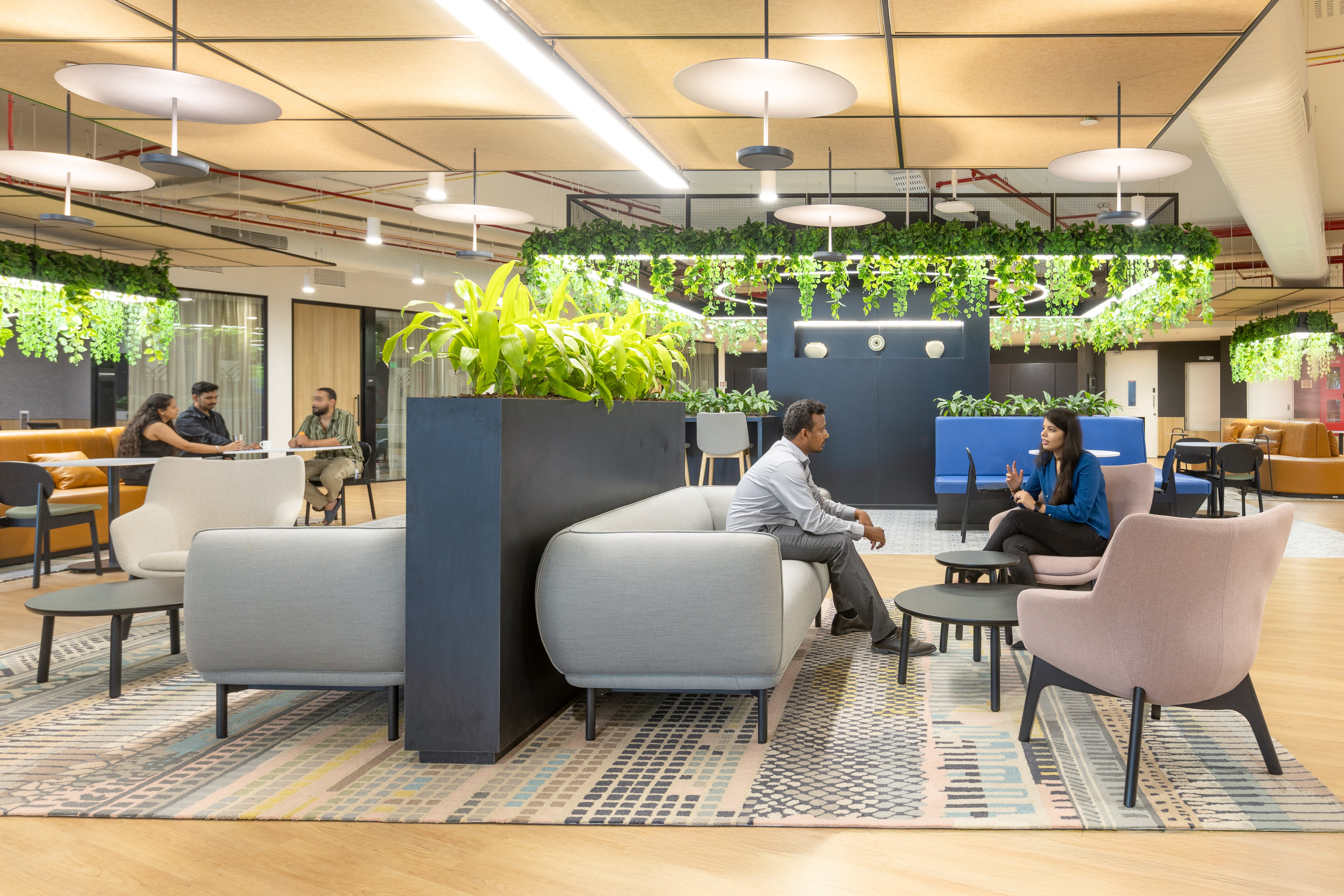 BlackLine Bangalore Uses Connectivity to Drive business Performance
2. Flow Determines Experience
Queues are everywhere in the workplace: reception areas, cafés, elevators, meeting rooms, and collaborative zones.
Poorly sized or positioned amenities create friction that employees experience daily.
Understanding flow dynamics enables designers to predict demand and right-size spaces based on actual patterns rather than rough assumptions.
3. Adjacency Can Be Optimized
Departmental placement is often debated qualitatively: “Marketing should sit near Sales,” or “Innovation should be close to leadership.”
But adjacency can be modeled quantitatively by assigning relationship weights between functions and minimizing operational distance.
This turns workplace planning from preference-driven layouts into evidence-based optimization.
4. Hybrid Work Is a Probability Problem
The biggest post-pandemic planning mistake is designing to average attendance.
Average occupancy does not account for variability.
Hybrid attendance behaves probabilistically, meaning workplaces should be designed to accommodate peak scenarios within reasonable confidence intervals—not simplistic averages.
This has major implications for desk ratios, collaboration settings, and portfolio sizing.
5. Complexity Influences Wellbeing
Humans are drawn to environments with a certain degree of visual and spatial complexity.
Too little variation creates monotony; too much creates cognitive overload.
The most effective workplaces strike a measurable balance between order and richness—supporting focus, comfort, and emotional engagement.
This offers a new lens for evaluating materials, patterns, spatial layering, and environmental design.
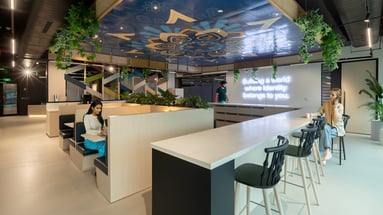
 Wellness room ofHPX Group in Australia supports employee wellbeing
6. Distance Impacts Collaboration
Collaboration declines dramatically as physical distance increases.
Even in digitally enabled organizations, proximity remains one of the strongest predictors of interaction frequency.
This reinforces the strategic importance of team placement, neighborhood design, and minimizing fragmentation across floors or buildings.
In other words: where people sit still matters.
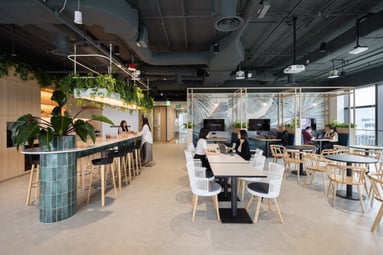
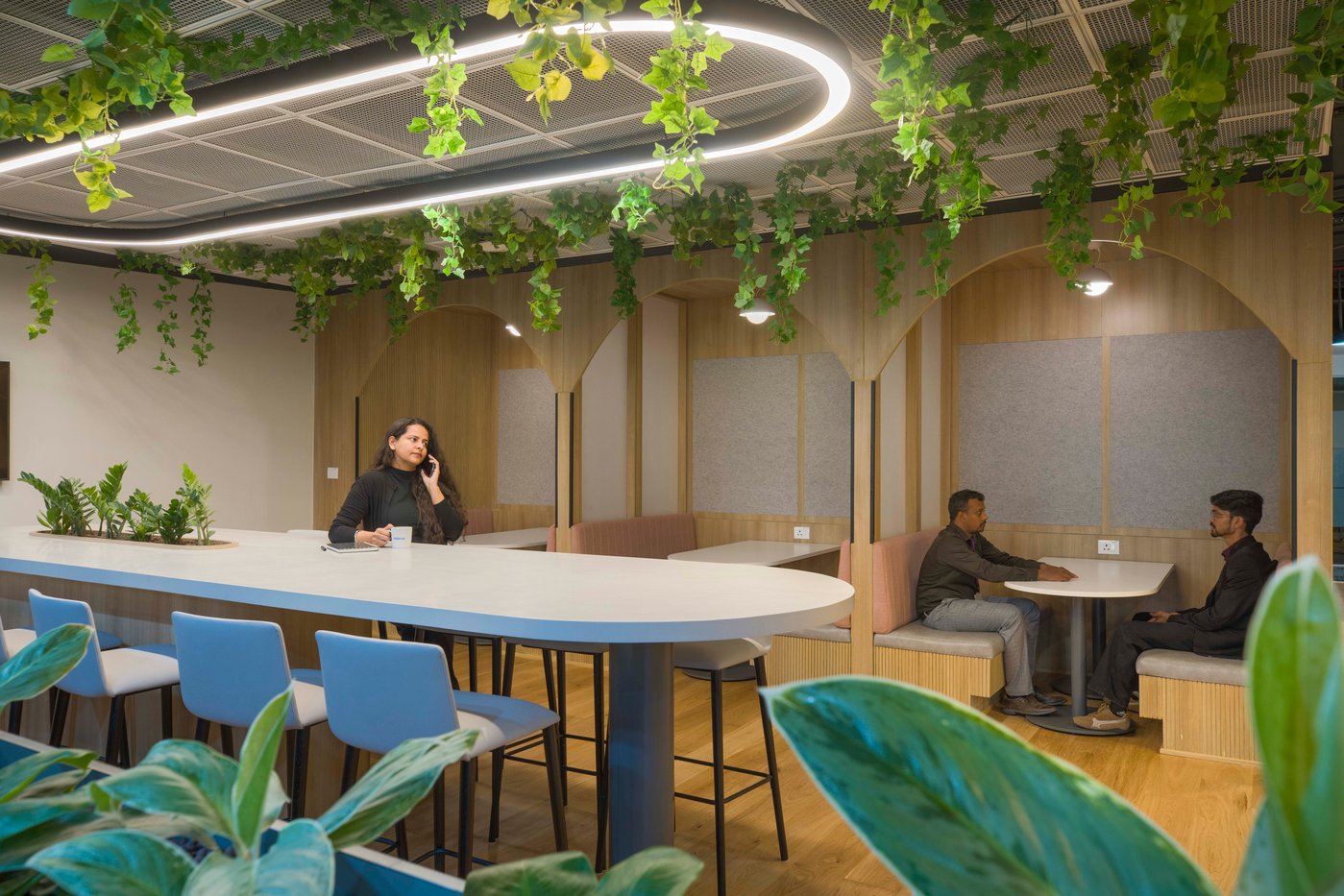
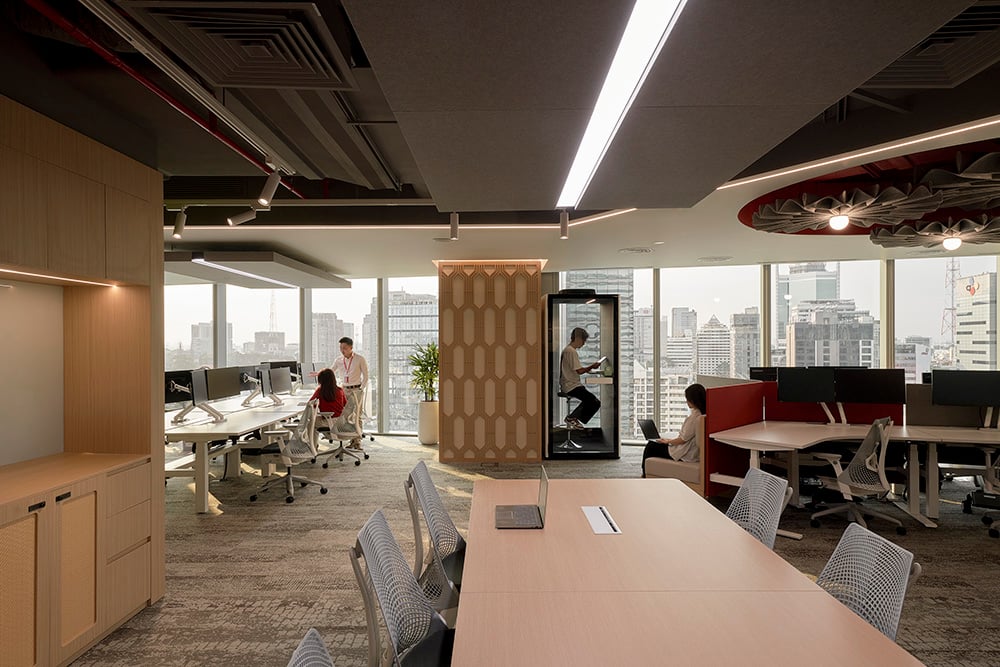 Takeda Vietnam with dedicated seats, shared space and private space to meet employees' needs
7. Flexibility Has Quantifiable Value
Lease flexibility, expansion rights, and portfolio optionality are often discussed strategically but rarely valued rigorously.
In volatile business environments, adaptability is an asset with measurable economic value.
A workplace portfolio should therefore be viewed not only as a cost center, but as a portfolio of strategic options.
Mathematics Does Not Replace Design. It Elevates It.
A common misconception is that mathematical rigor makes design cold or mechanical. The opposite is true. A more scientific approach allows workplace strategists to design with greater intentionality: for inclusion, collaboration, wellness, and performance. It gives organizations confidence that decisions are not merely fashionable or anecdotal, but grounded in defensible logic. The role of the designer remains deeply human.
Culture, aspiration, identity, and emotional resonance cannot be reduced to equations. But mathematics can eliminate avoidable errors and improve the quality of strategic choices. It can answer questions like:
- Are we allocating enough collaboration space?
- Will this adjacency model improve cross-functional interaction?
- Are we overcommitting on real estate?
- Is this layout supporting or hindering employee experience?
These are questions every client is already asking—explicitly or implicitly.
The industry now has an opportunity to answer them with greater precision.
A New Era for Workplace Strategy
The workplace is no longer just a place.
It is an ecosystem shaped by movement, probability, behavior, economics, and human connection.
As organizations rethink their real estate strategies for a hybrid future, the most successful workplaces will not simply be the most beautiful or trend-aware.
They will be the most intelligently designed.
At Unispace, we believe the future of workplace strategy will increasingly combine human-centered design with analytical rigor.
Because better workplaces are not built on instinct alone.
They are built on insight.
And increasingly, on mathematics.
About Swatasiddha Majumdar, Principal, Strategy, India

Swatasiddha (Sid) Majumdar is the Principal, Strategy at Unispace India, a global design and build firm that specializes in workplace strategy, design, project management, and construction. With over two decades of professional experience, Swatasiddha leads the strategic initiatives at Unispace, where he focuses on architecture, workplace strategy, and project integration management.
He holds a Bachelor of Architecture & Planning from the Indian Institute of Technology, Roorkee (1996-2001) & Postgraduate in Advanced Programme in Product Marketing from Indian Institute of Management, Calcutta. Sid is currently pursing his PhD in Design of AI Framework at Indian Institute of Technology, Delhi (2025-2030).
Follow Swatasiddha Majumdar on LinkedIn.