Workplaces today are at a turning point, where design, culture, and performance are more interconnected than ever. As organisations rethink how spaces function and what employees truly need, the conversation is shifting from infrastructure to meaningful impact.
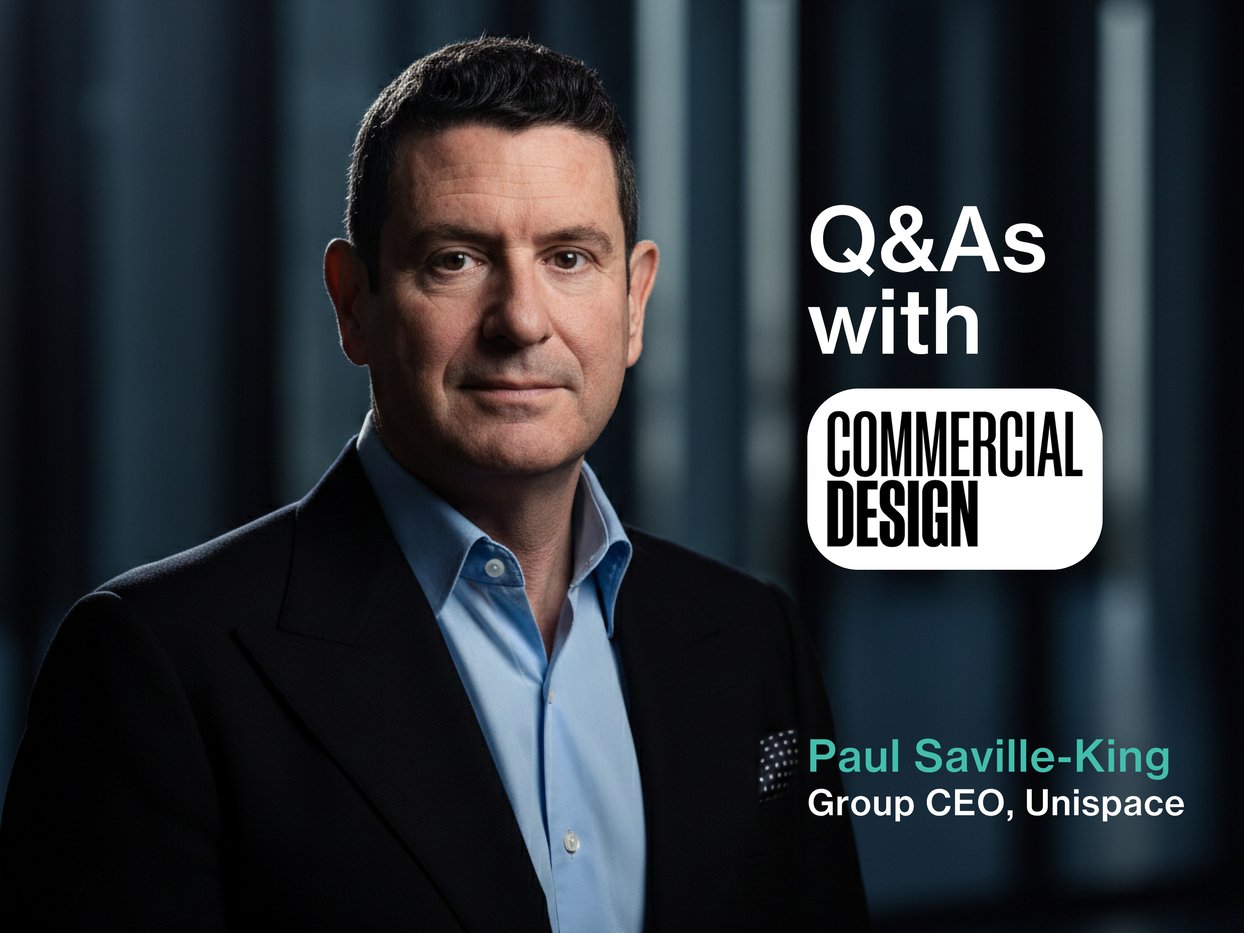
In this Q&A, Paul Saville-King, Group CEO of Unispace, speaks to Commercial Design India—a leading industry publication covering insights and innovations in commercial interior design across India—to share his perspective on this shift, drawing on his experience across global organisations, including CBRE. He reflects on leadership, the realities of modern workplaces, and why businesses must move beyond conventional thinking to create spaces that truly work for people.
You’ve spent over two decades in this industry. How did your journey begin? Was it planned, or something you grew into?
My journey was completely organic.
I started as an apprentice electrical engineer, young, ambitious, working at Honeywell and interested in the built environment.
After 17 years, my journey took me to Norland, which opened the door to facilities management, and project management. When CBRE acquired Norland, I found myself inside one of the world’s largest real estate businesses and discovered I was fascinated by how the whole ecosystem connects.
When you stepped in as Group CEO of Unispace, what was the first thing you wanted to change or accelerate?
My instinct coming in was to listen before jumping to conclusions. Unispace has genuine strength that attracted me. A differentiated model, very strong talent, and a real global footprint. The priority was understanding where that strength was fully realised and where we could go further, and what clients wanted from us.
One of the largest things that struck me early on was what clients were telling me directly. They are looking for outcome certainty for their projects, with tangible impact from the spaces they create; for their people and culture, for their business performance and for how their real estate serves their strategy. Not just a fit-out project.
I see this as an opportunity for Unispace to elevate our engagements even further in the future.
We are a strategy, design, and build company – but with a very big D. Most firms in our space lead with construction and bolt design on afterwards. We lead with insight and design. Our build capability means we can realise what we create without handing it off and hoping for the best. That is a fundamentally different proposition.
After more than a decade at CBRE, what’s one value or leadership lesson you still carry with you today?
There’s a quote, widely attributed to Peter Drucker, that culture eats strategy for breakfast. It’s overused, but it’s overused because it is true. I watched it play out repeatedly in different roles and companies across multiple geographies and business cycles. You can have a brilliant strategy on paper and still fail to execute it if the culture is wrong, for example if people do not share a sense of purpose, have belief in the vision or feel genuinely excited about where the business is going. That’s on leadership to fix.
What I also learned, is that culture is not a passive thing. It requires active attention. That means nurturing what is working, celebrating the behaviours that reflect your values, and being honest and sometimes quite direct about the things that undermine it.
That includes people. Negative cultural influences, left unchallenged, compound over time. Protecting the culture occasionally means making difficult decisions about individuals and doing it without hesitation when it becomes clear they are pulling in the wrong direction. We are all human so sometimes it’s hard to face for some leaders, but hard must not equate to not doing what’s right, or more people, the company, and clients will suffer in the long term.
What does Unispace offer that’s unique compared to other similar organisations?
The word that gets overused in our industry is integrated. Everyone claims to offer an integrated service. What most actually deliver is a coordinated service; different firms, different contracts, different incentives, brought together by a client who bears all the risk and complexity of making them work as one.
Unispace is different in that our strategy, design, and construction experts are on the same team, working from the same P&L, accountable to the same client outcome. When those three things are actually unifiedunified, not just presented as unified, you get better quality projects delivered faster and a much better client experience.
As a result, we eliminate the traditional complexity, wasted time, rework costs, coordination issues and program inefficiencies you see elsewhere, and invest those savings back into the project for our clients. That’s how we can promise zero variations, no punch list on handover, a fixed price at an agreed budget point, and a very high-quality finished product delivering real business impact.
Globally, only two or three firms can credibly deliver that model at scale across multiple countries. Most firms are excellent at one or two of those disciplines. Doing all three well, at genuine scale, is rare and we do that in 13 countries, across 27 Studios in most of the major markets our clients are looking for support.
A second and important differentiator is our research. Our Global Workplace Insights (GWI) programme draws on responses from over 77,000 employees across 14 markets. That gives us proprietary data about how people use workplaces, what brings them back to the office, and what many organisations get wrong about their real estate. We bring that into every client conversation and strategy engagement.
What does success for Unispace look like under your leadership – greater revenue, a larger footprint, or something deeper?
Let’s start with my view that success is not a single number. However, the metric that matters most to me is our client NPS. At the end of the day, clients are the sole judge of quality, and we want them to keep coming back and recommending us to others. That’s the acid test.
Sure, we want to, and will, grow materially. We have the head room to do that across all our studios globally, but we want to do that aligned around a sense of purpose. Making a material difference to the lives of the people using the spaces we deliver, and the companies they work for, is important to us. Outcomes that matter, matter.
What I want Unispace to be known for is being the firm clients choose when the project genuinely counts. When the brief is complex, the stakes are high, and they want total confidence their ambitions will be realised. That is the market position this business is built to own. Not the cheapest. Not the largest. The one you call when you need things done well.
Obviously, people are central to that mission. Unispace has exceptional talent across its studios globally. Creating an environment where those designers, project managers, and strategists can do the best work of their careers matters as much to me as any revenue target. I want our competitors to be green with envy at just how good our people are, and how much they love being part of the Unispace business.
How ambitious are the growth plans? Are you pursuing scale, impact, or both?
I am ambitious about growth for sure; however, I want sustainable growth that does not force a compromise on quality of delivery, so Unispace will be very disciplined in how we pursue that growth.
Scaling up and quality work are not in tension if you are clear about who you are, your target clients and markets, and what you do best. Also, it’s important to be very clear what we will not do. We will stay absolutely focused on what we do best and resist the temptation to chase work that takes us away from our core strengths.
Scale and impact are complimentary. Sustainable disciplined growth funds investment into our talent, technology, research, and tools, leading to improved capability. Improved capability secures more clients, attracts great people and enhances our reputation as a market leader.
Get the fundamentals right and the two reinforce each other.
You’ve led major transformations in global companies – what’s the hardest part of making change happen?
I work using a simple framework. Most transformations require four things to succeed: clarity, communication, measurement, and consequences.
When they fail, it is almost always the first two that break down first, and that failure belongs to the company, not the people being asked to change. If your teams do not have an unambiguous picture of where you are going and why, and what you expect them to do, no amount of effort further down the line will compensate.
Get clarity and communication right, and the other two become workable. You can track progress honestly, have direct accountability conversations, and course correct without it feeling personal or arbitrary. Measurement tells you where you are, and consequences give the whole thing tangibility.
That said, I have never been through a transformation that played out exactly as planned. The framework gives you discipline and direction. It does not make you immune to surprises. The leaders I have seen struggle most are the ones who confuse having a good plan at the outset with a predictable journey. They are not the same thing, so you need to be agile, focused and attentive to adjust as things unfold.
With hybrid work now widespread, what do you think most companies still misunderstand about the workplace?
The biggest misunderstanding is still that this is a debate about where people sit and how many days they come in. It is not. Our own Global Workplace Insights 2025-2026 (GWI) research makes that very clear.
We surveyed over 5,200 employees across 14 markets last year, supported by over 77,000 responses accumulated over recent years. What we found is that most offices are simply not fit for purpose. People are ready to work. The workplace is the thing letting them down.
The number one barrier to performing at their best was not commuting or flexibility but noise and distractions: by a significant margin.
75% of employees told us that noise and a lack of quiet focus space prevent them from doing their best work. 80% said the office has more distractions than working at home.
The second thing companies get wrong is believing that mandates solve the problem. Our GWI research shows the US leads the world in full-time office mandates, and yet it also carries some of the highest office vacancy rates globally. As our data indicates, mandates don’t necessarily lead to increased attendance. Pushing people back by force does not make the office worth being in or deliver better outcomes. Only better spaces can do that.
What employees told us they need is straightforward. Calm. Comfort. Customisation. Spaces that are easy to use, properly equipped, acoustically considered, and designed around how they work today and not how someone imagined they might work in 2019.
The same research found that 98% of Indian employees still see a need for the office in 2030 – the highest of any market we surveyed globally. The appetite exists but the question is whether the spaces being built are worthy of it.
Looking back on your career, which decision or moment most significantly changed your trajectory?
I came from a very working-class background and was not academically successful at school. When I entered the workforce, I carried a quiet sense that I did not quite belong at the table with people who had taken more conventional routes or had more privileged backgrounds.
Leaving Honeywell where I enjoyed security but felt like just another cog was the decision that changed everything for me. I chose to join Norland, a privately owned UK business then turning over twenty-nine million pounds yet showing no profits. My motivation was to make a tangible impact. Although most people thought my choice was peculiar and risky, I wanted to create real change.
What I could not have anticipated was that as the business improved, Norland would sponsor my MBA, something I thought I could never do, and that throwing everything into it would result in coming first in my class.
Finishing this was not about the certificate or qualification; it was the moment I stopped questioning whether I could operate at the highest level, and when I first connected all the dots of general management.
I had learned a new language – the language of business.
That confidence, combined with what I learned and applied, gave me the platform to build what became the market leading data centre outsourcing business globally. Norland grew to circa £600M revenue organically and sold to CBRE in December 2013.
My lesson was that the barriers we imagine are usually larger and scarier than the ones actually in front of us. Sometimes, you just need to back yourself and follow your instincts.
As Henry Ford allegedly once said, “Whether you think you can, or think you can’t – you are right”.
Check here to read the coverage.