Unispace Global workplace and office design trends 2026: designing what actually works
The conversation about the office has changed.
It’s no longer a question of whether offices still matter. Most organizations have already answered that. The more pressing issue now is whether their spaces are actually working—for people, for performance, and for how work really happens today. Hybrid work, AI, and generational change haven’t made offices obsolete. They’ve made weak ones obvious. Based on insights from our 2025–2026 Global Workplace Insights research and what we’re seeing across projects globally, six clear trends are shaping how workplaces need to evolve in 2026. They’re not about novelty. They’re about fixing what isn’t working.
Download Global workplace and office design trends 2026
Six trends shaping the workplace in 2026
- AI is no longer just a tool.
It’s becoming an active part of how work gets done, and how workplaces respond to people in real time. - Occupancy is a vanity metric.
The real measure of success is how well a space supports the people using it. - Hybrid work exposed the basics we got wrong.
Noise, distraction, oversized meeting rooms, and environments that don’t support focus have become impossible to ignore. - Younger generations expect difference, not uniformity.
Millennials, Gen Z, and a more neurodiverse, multicultural workforce expect choice, flexibility, and environments that adapt to them. - Less lounge. More usefulness.
Employees are clear about what they need: the right-size meeting rooms, quiet spaces, reliable desks, and technology that works. - Environmental sustainability is a baseline requirement
Regulations, costs, and employee expectations demand smarter materials, cleaner energy, and long-term resilience.
Each of these trends reflects a simple truth: people now choose when and where they work, and workplaces have to earn that choice.
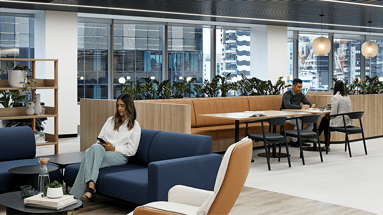
Zoom’s Employee Engagement Hub caters to various workstyles with community, hybrid collaboration, and focus zones.